There is this practice called Deep Relaxation. Just to be clear this is not specifically a yoga exercise. Though most often when doing it you take the savāsana position or lay on your side. The technique could be compared to yoga nidra, though that term is sort of esoteric and not familiar to most practitioners. It is also not meditation in the strict sense of the word. Where in meditation one tries to stop and focus, deep relaxation is a surrendering to the fatigue and stress in our body. Yet then again it is not a nap, though one might fall asleep while doing it; usually waking up a little later in a soft repose that is often healing and nourishing.
Relaxation is essential for accessing the tranquility and joy that lead to increased personal well-being.
If you are like me, you will approach this exercise with a degree of doubt and skepticism. So be it. I’ve never liked naps because usually they leave me tired and disoriented in the middle of the day. Yet this practice is something altogether different. I often do this after a long bike ride, where I’m physically exhausted. It works wonders. For you, it might be helpful after a day of working from home, looking at a screen for too many hours and feeling scattered or dispersed.
This is your assignment: Lie down in a comfortable position and listen to this guided Relaxation. This Relaxation audio is offered from Sister True Dedication from the Plum Village tradition. I chose it, because she has pleasant voice and it’s only 15 minutes long. So the time commitment isn’t that much. Try it. You perhaps will find it healing.
“When we relax, we become calm water, and we will reflect reality as it is. If we’re not calm, the image we reflect will be distorted. When the image is distorted by our minds, it’s not the reality, and it causes lots of suffering.”
This practice sequenceis very short, but intense (rajasic). The feel is very energetic while helping with focus. If you feeling sort of anxious or antsy, these poses can be very helpful. Yet the poses are basic and you are familiar with them all. I encourage you to go through it once, skipping the last two poses and repeat from the beginning including the last two. Especially if you’re still feeling restless.
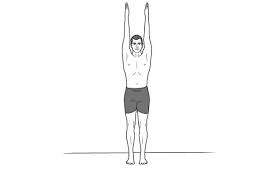
Urdhva Hastasana coming from Tadasana. Palms facing inward with fingers and thumb together. Repeat 2x.
Utkatasana coming from Tadasana. Palms pressing together, keeping knee in line with ankles and hips . Repeat 3x going lower each time.
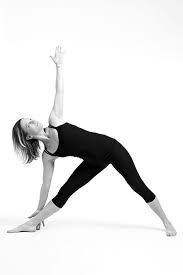
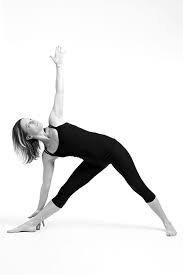
Trikonasna/triangle pose: Use a block or prop as need be, but repeat 2x each side and see if you can get lower on second attempt. Keep both legs very strong.
Utthita Parsakonasana /side-angle pose: Use a block or prop as need be, but repeat 2x each side and see if you can get lower on second attempt. Keep both legs very strong.
Vimanasana bring arms out, turn toward the bent knee, lifting and pivoting the back heel. Lift chest forward and up utilizing arms to help with balance and strength. Repeat 2x on each side.
Vibhradrásana 1 / warrior 1 Plant back heal down and in, turning front of legs out vigorously. Push head of back hip forward and sink hips as low as you can; then lower. Don’t allow forward knee to project ahead of the ankle. Repeat 2 or 3x on each side.
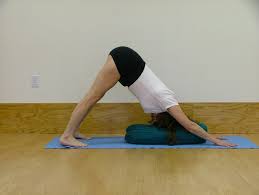
Adho Mukha Svanasana / downward -facing dog pose. Repeat 3x moving into the planks pose between. Notice your breath while doing. It should be strenuous enough to make you breath hard.
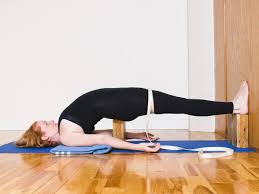
Catuspadāsana / bridge holding ankle. Hold the ankles in this pose. If unable to reach, then us a strap or a belt. Hold and breath for about 30+ seconds. Repeat 2x releasing slowing and mindfully. .
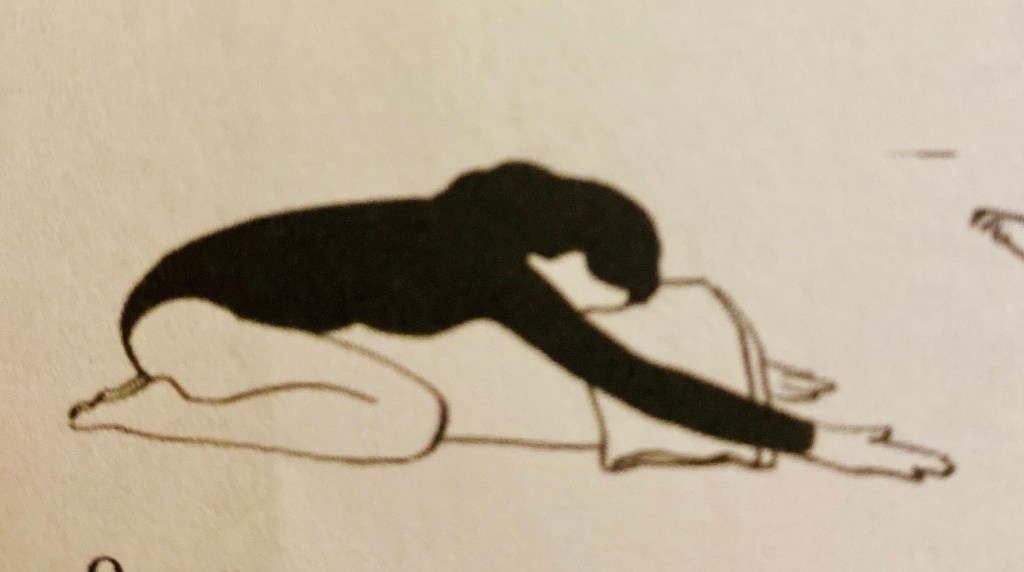
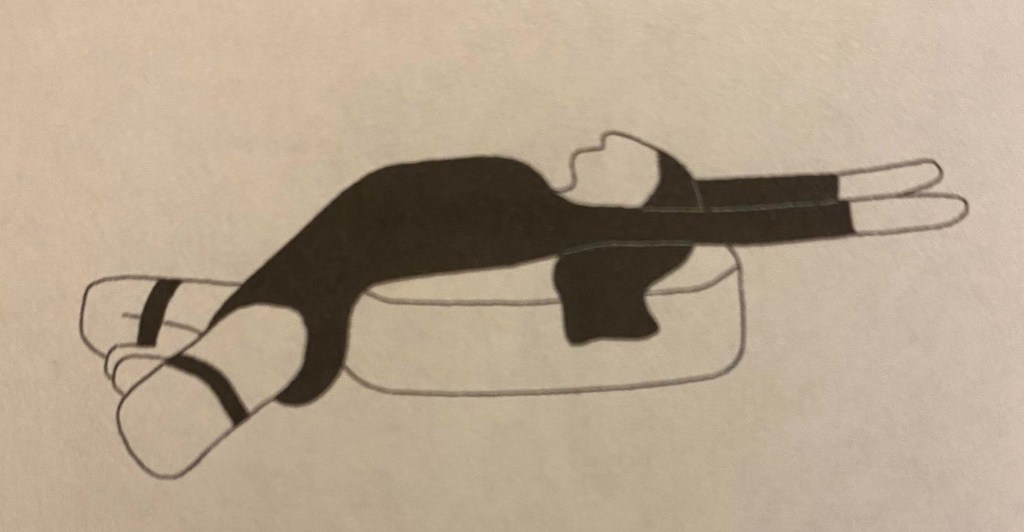
Adho Mukha Virasana with support. Try to find a cushion or blankets to get the head the same height at the hips. Legs are apart, arms are forward. Breath and hold.
Savasāna/corpse pose. Yes finally you get to do savasāna! Remember this is a pose too, so come out of it slowly and intentionally as you’ve learned.
“Yoga is the method by which the mind is calmed. And the energy directed to constructive channels.”
March is at an end. Any other year we would have done Sun Salutations together in class. The classic sequence would have offered a variety of teaching opportunities. We would have dissected the poses, explored ways to refine and improve our technique. Done them quickly in succession, slowed down to savor the energy being expended, practiced with our eyes closed, then faced the sun to surrendered our efforts to the cosmos. But this was not a typical March this year. Most of this was abruptly halted due to the reality of a collective corona contagion.
Yet some of you told me of your endeavor to continue on with the goal of 108 salutations. Some of you even let me know that you completed them. Some of you, finished just today. I congratulated all who finished, but am equally gratified by those who did what they wanted. But the true treasure here is doing them for yourself and for those who touch your life.
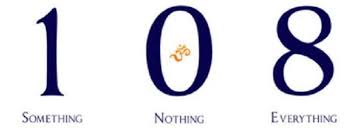
Some of you know this number 108 is considered sacred, and continues to pop up in not just in yoga, but in nature, spirituality, and mathematics.
Exactly how the yogis arrived at 108 is not quite certain, but it seems to be a number that connects us to our place in the cosmic order. The distance between the Earth and sun is 108 times the diameter of the sun. Around the time the ancient Vedic texts were being collected, far away Stonehenge was built—the Sarsen Circle is 108 feet in diameter. In Belize, during the era of the Mayans, the High Temple of Lamanai was erected at 108 feet tall—the same height as the funerary Tikal temple in Guatemala. And within the temple of Kukulkan at Chichen Itza in Mexico archeologists believe there to be a second pyramid inside measuring 108 feet wide. Is it possible that our ancient ancestors knew this? These temples, built to worship and to house the souls of great leaders upon their death, perhaps used this number to connect humans not just to our sun as a giver of life, but to the Creator.
In yoga, the number 108 refers to spiritual completion. It is why japa malas are composed of 108 beads. In other spiritual teachings beyond the traditional yogic texts, this number comes up repeatedly in the search for liberation. The ancient yogis believed that if we could align ourselves with the rhythm of the creation, we would ultimately bring an end to our cycle of reincarnation.
Hindu deities have 108 names, and India is said to have 108 sacred sites. In Jainism there are believed to be 108 virtues. In some forms of Tai Chi there are 108 moves. In Tibetan Buddhism there are 108 delusions. Many Buddhist temples have 108 steps representing the 108 steps to enlightenment. While in Japanese Zen Buddhist temples, a bell is chimed 108 times at the end of the year closing a cycle to serve as a reminder of the 108 earthly temptations a person must overcome to achieve nirvana.
In mathematics 108 brings a whole host of equations and possibilities most of which I can’t explain. But one simple examples is: if you square 2 you get 4 and if you cube 3 you get 27, and if you multiply 4×27=108. Galileo said the universe is written “in mathematical language”— that the mysteries of creation itself could be unraveled through numbers and equations. For the yogis, that code is 108.
Yet none of these numbers or what they symbolize are really to the point. Whether one does 108 or 27 or 2 squared, the most pertinent sun salutation is the one you are doing now. In moving from one pose to the next, you realize that you can embody the practice, this ancient teachings through movement. It doesn’t have to be perfect or precise. Surya Namaskar becomes beautiful when we take these poses, one after another, into our bodies in ways we never could by just talking or thinking. So when we walk away from having done them, we join with the mystics who offered a code for awakening, a code to our own nature.
I’m late getting today’s entry out. The day was sunny and warm, so I went for a bike ride. There were strong northwest winds that I rode into until the headwind just felt like the normal way of things. The wind blew stiffest through open valleys and over the tops of hills, reminding me that it was always present and that it could knock me over at any time. But when I turned to go home, it pushed me along as though I was entitled to this luxurious easy pace. Almost like I was taking a friend for granted.
Here’s a poem by the Irish poet John O’Donohue that I wanted to share with you. It reminds me that some days it’s okay to let the wind blow you; to coast on the drift of your efforts.
THIS IS the time to be slow, To lie low to the wall Until the bitter weather passes.
Try, as best you can, not to let the wire brush of doubt Scrape from your heart All sense of yourself And your hesitant light.
If you remain generous, Time will come good; And you will find your feet Again on the fresh pastures of promise, Where the air will be kind And blushed with beginning. ~ John O’Donohue
I’ve been hearing from some of you that in the midst of social distancing and our self-imposed remoteness, you are feeling somewhat antsy and dispersed. Today’s sequence* might help with that feeling. It starts out active with some standing postures, then spirals into a more introspective poses. Give yourself room to sink into these quieter poses. Their simplicity can perhaps mislead one to thinking they are easy or insipid. But stop and dive down into the intricacies of each asana. The stillness offered can sometimes be quite intense.
Trikonasna/triangle pose: Use a block or prop as need be, but repeat 2x each side and see if you can get lower on second attempt. Keep both legs very strong.
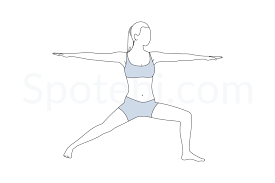
Virabhadrasana 2:Repeat 2x each side and see if you can get lower on second attempt. Keep both legs very strong.
Ardha Uttanasana / half forward bend: With hands on the wall at hip level or higher so you can strive for a concave back. Keep legs very straight. Do 1x but hold.
Parsvottanasana / side-angle forward bend: Leave hands on hips and try to maintain a concave spine. Repeat 2x each side and see if you can you can get lower on the second attempt.
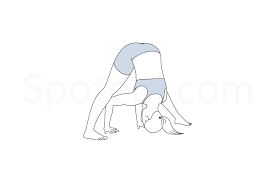
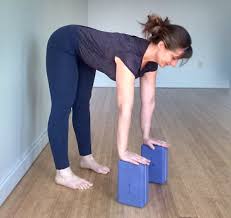
Prasarita Padottananasana / wide legged pose: Start with hands on floor, straight arms, and concave back. Then lower head to floor or block. Repeat 2x.
Sukhasana/simple sit: Simple crossleg position. Do on a folded blanket to get hips the height of the knees. Switch leg position or (if you’re feeling adventurous) twist to each side but be kind to knees. Repeat 3x
Baddha Konasana / bounded angle pose: Get the back supported against the wall or couch. Use your arms behind you as pictured to learn to get spine straight and strong. Get the outside legs supported as needed. Hold for several minutes with back straight; read a poem.
“Yoga does not just change the way we see things; it transforms the person who sees.”
BKS Iyengar
Vajrasana (urdhva Hastasana & Parvatasana): Sit with heals and knees together under you placing a rolled up blanket between calves as needed. Bring straight arms up in line with ears (urdhva hasta) then repeat interlacing fingers and palms turned up (parvata).
Adho Mukha Virasana with support. Try to find a cushion or blankets to get the head the same height at the hips. Legs are apart, arms are forward.
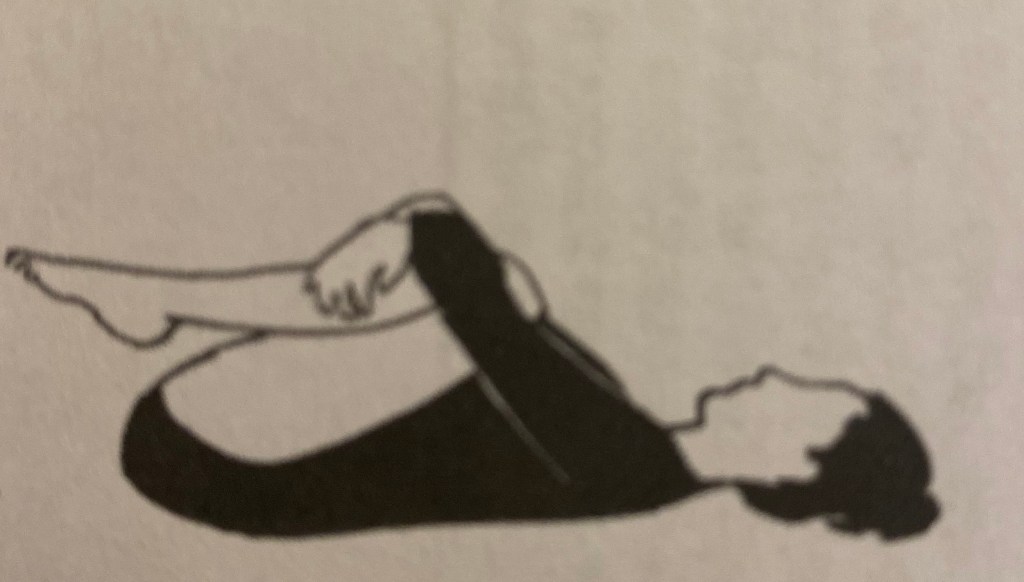
Pavanmuktasana: Remember you can stuff the hands behind the knees. Play around with the legs to going into the happy baby pose rocking from side-to-side.
Adho Mukha Svanasana / downward -facing dog:Repeat 2x after short rest between.
Supta Baddha Konasana: getting support for the back, head, and outer legs too. Should be comfortable because again there is no savasana in this sequence.
*These sequences originate from the Iyengar Institute of New York.
For those of you who are perhaps a little tired of Sun Salutations (if that could be possible?) here is a home practice sequence Level 1. Many of the poses get repeated 2x or 3x. Repeating poses is a very fruitful way to deepen your practice. The first time is stopping (shamata) and the second time leads to insight (vipassana). Enjoy!
1. Tadasana/ Mountain pose. Alternate by swinging straight arms forward up into urdhva hastasana. Repeat 3x.
2. Move from tadasana to urdhva baddh-anguliyasana (interlocking finger over head with palms turned upward). Repeat 2x changing the finger interlock.
Vrkasana /tree pose; face a wall or use a wall, but do try to get the arms overhead as pictured. Do both sides 2x. Notice your breath.
Trikonasna/triangle pose: Use a block or prop as need be, but repeat 2x each side and see if you can get lower on second attempt. Keep both legs very strong.
Utthita Parsvakonasana/ side-angle pose: Use a block or prop as need be, but repeat 2x each side and see if you can get lower on second attempt.
Parsvottanasana / side-angle forward bend: Leave hands on hips and try to maintain a concave spine. Repeat 2x each side and see if you can you can get lower on thy second attempt.
Prasarita Padottananasana / wide legged pose: Start with hands on floor, straight arms, and concave back. Then lower head to floor or block. Repeat 2x.
Adho Mukha Svanasana / downward -facing dog pose. Repeat 2x after short rest between. Rest could be Adho Mukha Virasana / Downward Hero pose.
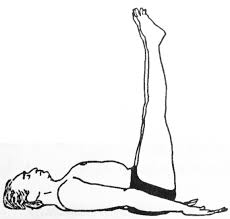
Urdhva Prasarita Padasana / legs up the wall: Back is flat on the floor. come away from the corner if the back hips are not on the floor or legs are bent. Rest quietly here for at least 5 minutes. No savasana.
I’m sharing a writing from a renown yoga teacher, Tias Little, who along with his spouse, Surya, established Prajna Yoga. I have enjoyed and been influenced by his teaching for many years. This teaching on Shamatā/Stopping was timely and particularly relevant to our current situation, so I felt it was worth sharing.
I appreciate that Tias uses the term: “the Power of Pause,” to describe the benefits of this practice of shamatā. The use of the word “pause” — offers a fresh perspective to this term we’ve been trying to understand and incorporate into our lives. Also in the second paragraph, he uses the term “sattvic.” You practicing students will of course remember that this is in reference to the Three Gunas: the three aspects of nature Sattva is a state of harmony, balance, joy, and intelligence. Rajas is a state of energy, action, change, and movement. Tamas is a state of darkness, inertia, inactivity, and materialism.
The Bright Side of the Sun
In the face of the fast-moving Coronavirus, all of us are no doubt experiencing creeping pangs of fear. Anxiety crawls through our gut, and dread lodges in our shoulders and neck. Surya and I are worried for our families and members of our community. Fear is palpable on the street as the existential threat to health, livelihood, and survivability continues. We are seeing people respond through consumptive grasping — buying up groceries, hand sanitizer, and TP. Yet under the lining of despair, there is, for those of us engaged in ongoing and deep practice, opportunity for harvesting a kind of potency at this time.
First off, there is the Power of the Pause. While our lives barrel lickety-split down the track, we are now suddenly encouraged, in fact mandated, to take our foot off of the collective accelerator. If we do not succumb to panic we can exhale. As the world brakes and the buzz and burn of traffic is reduced, the atmosphere all around is more serene, sattvic. Not since the tragedy of 9/11 have we come to such a collective halt, and in the midst of the break we are led to wonder, will we ever experience such space and quietude again in this lifetime? Perhaps this momentous brake/break will enable a Big Shift and clarify our intention to take care. In the pause we exhale, we let go of urgency, rush, and demand. Like in pranayama, when the breath is interrupted between cycles and the entire physiology can reset, we have an opportunity to press the “refresh” button. I always say in SATYA practice, “let the pause do its good work.” The pause allows us to shapeshift into something new and unforeseen. In the process of meditation and yoga, the pause (called nirodha) is essential to transformation — the shedding of the old habit of being. At the very least, and this is great in and of itself, the pause is an invitation to just be.
Each of us wonders, how long will this viral threat last? Will it metastasize and effect us all? Is the person in front of me in line at Trader Joe’s contagious? This is a reminder of another tenet of practice: Not Knowing. Not knowing involves witnessing impermanence, seeing that everything is in flux, from the outermost galaxy down to the cells in your spleen. That everything is “fluxing,” mutable, and uncertain lies at the heart of the Buddha’s teaching on transience. Through a lifetime of practice, we learn to breathe through uncertainty. And it is through not knowing that we attend to the great mystery. There is no better time than now to peer back over our shoulder and ask, “what have we been doing?” and look ahead and ask, “how can we come to a collective homeostasis?” In the hermetic quarantine that we are now in, there is a cache of real gifts to be uncovered. One is the reckoning that we have have been scorching the very earth that sustains us, with a hellbent urgency for more, bigger, better. The other is the acknowledgment of just how fragile and precious this terrestrial life is. We come to a sincere appreciation for the very fabric of social networks that sustain us — schools, supply chains, farmers, health care providers, sports, the press and… each other. In the midst of the shutdown (and before it all starts up again) our obligation to protect and preserve this treasure-filled blue globe is made all the more clear.
Spiritual seekers have long sought isolation as the fertile ground for revelation, compassionate presence, gratitude, and vision. While we bide our time in our own homes and spaces, may we not tremble in fear like caged rodents, but put into practice the very peace and resolve needed to sustain the wonder of the world that is ours.
One of the things I’ve come to appreciate about teaching at the Yoga Path, is the community that has formed around it. People of various backgrounds show up for different reasons to take a yoga class. There is usually a tumult of chatter while students set out mats and gather props. When someone shows up for the first time, I don’t worry much about trying to make them comfortable, because I know veteran students will welcome them, show them how to set up, and make them feel at home. Sometimes I worry about the introverts (this practice seems to draw the introverts) who possibly might be overwhelmed by the overtures, thus pulling them away from their comfortable nest of anonymity. Yet this welcoming, inviting atmosphere prevails through the entire class and is consistent in every class.
While I was fortunate to come from such an environment in my training with Margaret Hahn at the Omaha Yoga School, this is not, to my experience, typical of most yoga schools. Usually in other spaces, one is consigned to the space of your mat. Those who know one another huddle up at the beginning of class and head out after for chai and tea. I don’t mean to sound critical of other schools, but the culture at the Path is something altogether unique.
We never set out to create this atmosphere. In fact if I had tried to do it, when starting the Path, I wouldn’t have had the foggiest notion of how to begin. Or to even have envisioned what it could look like. Yet somehow it evolved into a community beyond all expectations. Maybe it’s the narrow confined hallway of a studio where we practice. Maybe it’s the tea we share after the asanā practice to discuss some aspect of yogic philosophy. Maybe it’s because many students are literally family members who bring other friends and family to this practice.
In Buddhism there is the word sangha. The easy translation is community, but this doesn’t quite capture the essence of the term. Thich Nhat Hanh describes a sangha as a community of friends practicing the dharma (teachings) together in order to bring about and to maintain awareness. But also I’ve slowly learned that collectively we augment our practice in a way that we could never do alone.
Another way to look at it come from the New Testament, Matthew 5:13: “Ye are the salt of the earth; but if the salt hath lost its savor, wherewith shall it be salted?” In this passage, Jesus describes his followers as salt. Food needs salt in order to be tasty. Life needs flavor to foster understanding, compassion and harmony. That’s why we come together in community.
ASSIGNMENT: In this time of distancing, where we need to be physically apart, I’ve enclosed this video. It reminds me of the Yoga Path sangha. Your assignment is to take six minutes and watch it, and know that you are part of this community.
For the next few posts I will talk about how to practice on your own, offering various themes. Today it will be a sequence that BKS Iyengar offered right after the 9/11 tragedy: It was titled:
Yoga Sequence For Times Of Crisis*
The emphasis is to build up one’s emotional strength, not physical stamina or flexibility. With that in mind, here are some specific recommendations as to how to move through these asanas: ~No standing poses. No backbends. ~All poses should be done with eyes open (including savasana). Try to flatten your vision if you know how or at least notice where you gaze is going and try not to let it drift. Or imagine your eyes are located at the temples and to “open” these eyes. ~Do not worry about a perfect pose. However, while breathing in any asana, breathe in such a way that the breath touches the lateral side of the chest during inhalation. ~Be patient and hold each pose from 2-5 minutes
1. Savasana (corpse pose; can be done supported on a bolster or blankets. Be comfortable but not sleepy. Remember eyes stay open.)
2. Supta baddha konasana (reclining bound angle pose. This can be done supported on a bolster or blankets and with a strap if you have one.)
3. Supta virasana (reclining hero pose; can be done supported on a bolster or blankets. Prop yourself up on a chair or stairs if this difficult for you. If this not doable because knee pain, just do the prior pose longer.)
4. Prasarita padottanasana/wide legged forward bend (Make sure the head is supported.)
5. Uttanasana /standing forward bend (again with arm support on a block or chair.)
6. Adho mukha svanasana /downward facing dog pose (again get the head supported.)
7. Viparita dandasana inverted staff pose over a chair or firm cushion (strapping the legs around the mid-thigh is recommend)
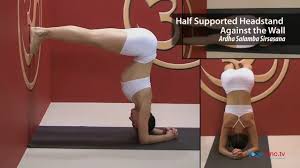
8. Sirsasana / headstand (against the wall if you want or do the “preparation poses” for as long as you can. Try to do some version of this as as safely as you can, but don’t skip it.)
10. Setu bandha sarvangasana (supported bridge pose, try make it accessible but not too easy)
11. Sarvangasana / shoulderstand (this can be done supported on a chair or from the wall as we practiced in class. If you have difficulty holding, lapse into halasasa / plow pose; again from the wall.)
Pranayama: End with Antara kumbhaka a very short retention on the inhalation. (This is just holding the in-breath just a little longer than normal. Do this in a comfortable, stable seated pose. Just notice the desire to breath out, then exhale. Don’t strain the breath here. You may notice your inhale grows deeper.)
*Please refer to BKS Iyengar, Yoga: The Path to Holistic Health
One of you emailed to ask if there could be a discussion about shamatā, the first wing of meditation. Shamatā as you all recall from the Winter session was practice of stopping, pausing.
Given the current situation in our world right now, this practice seems almost to have been enforced upon us. Some of us have stopped going to work, our kids are out of school, we’ve stopped going to movies, shopping, and going out to eat.
You could literally stop what you are doing, set it down for now and let yourself just be, rather than do. But it was also giving yourself space and time to just realize what is happening in the present moment. You don’t even have to stop what you are doing, you just allow your perception to shift to notice what you are doing. Instead of doing a thing, you let yourself notice this thing you are doing. This morning I was making breakfast when I “stopped” long enough, just for a moment to realize I was making breakfast. I didn’t stop what I was doing, I just noticed for a moment, there was this act of making breakfast. And that I was the actor.
It is not usually a big deal to “stop” in this way. Some might say I do it all the time. But actually most of the time we stop to do something else or to think about something else, or to remember something we forgot or need to do. We do deliberately stop, pause to see what is occurring right now. When we do though, the texture of the experience changes. Usually not dramatically, but subtly.
You could even call it sublime. You take a breath, see the activity in a less frenetic way. There is less possessiveness to the outcome of the action along with a feeling of spaciousness, sometimes even wonder. All just from “stopping” shamatā.
“When we learn to stop and be truly alive in the present moment, we are in touch with what’s going on within and around us” Thich Nhat Hanh