The Yoga Path • Omaha, NE

Icon

{ Practicing Physical, Mental & Spiritual Health }

How are Sun Salutations going?

“Asana, one of yoga’s most significant “tools,” help the sincere student develop physically and spiritually. The ancient sages believed that if you put your whole heart into your practice, you become master of circumstances and time.” BKS Iyengar

You knew I was going to ask. Now that classes are suspended, I can’t bug you in person before each class as to how’s it going with your 108 sun salutations? But now that we’re all distancing ourselves and settling into the new normal that is our life, the practice of yoga is now available in new ways. Surya Namaskara is the ideal entrance into a daily practice.

For those of you unfamiliar to the Yoga Path history, every March students and teachers at the Path commit to do 108 sun salutations for the month. The shared endeavor has been nicknamed “March Madness.” Some students talk about this event as early as the beginning of the year. Others avoid the subject with a quiet dread and contempt. Some rebel at the idea of keeping score, while the more analytic types, map out their plan to complete the goal on or before deadline.

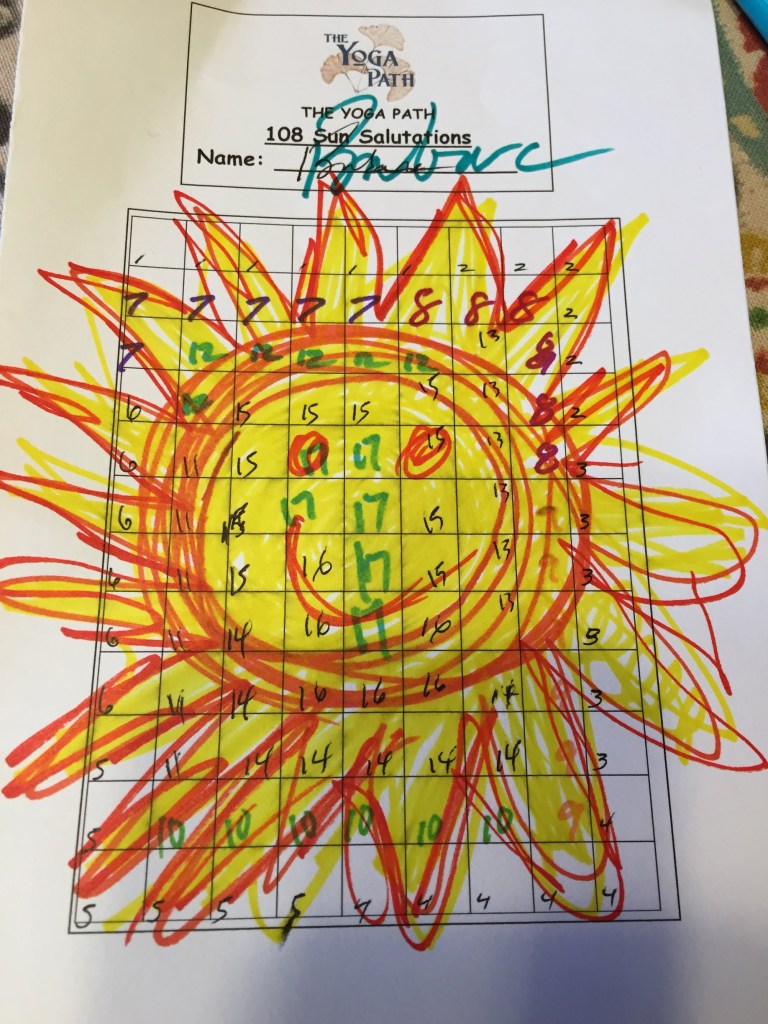
I don’t remember how this tradition even got started, but was surprised and gratified to discover that, for some, they actually took their practice home. We created a card to track our progress with 108 squares. Some would even come to class earlier than usual to knock off a few before class started. One of my students reported that she would do a couple of them every evening, during the commercials while watching the news.

First completed card 2020

Some resist this regimenting of yoga with all their might. Some just don’t like the sequence. But whatever gets people practicing on their own, to me, is a good thing.

I usually encourage students to use surya namaskara as a starting point for practicing. Don’t worry about the amount you do, but how it feels while doing them. Sometimes the first couple don’t seem very worthwhile, like the beginning of run, but let yourself settle into the flow of the sequence. Or just start with a salutation, but leave it behind if the body needs to do other asanas.

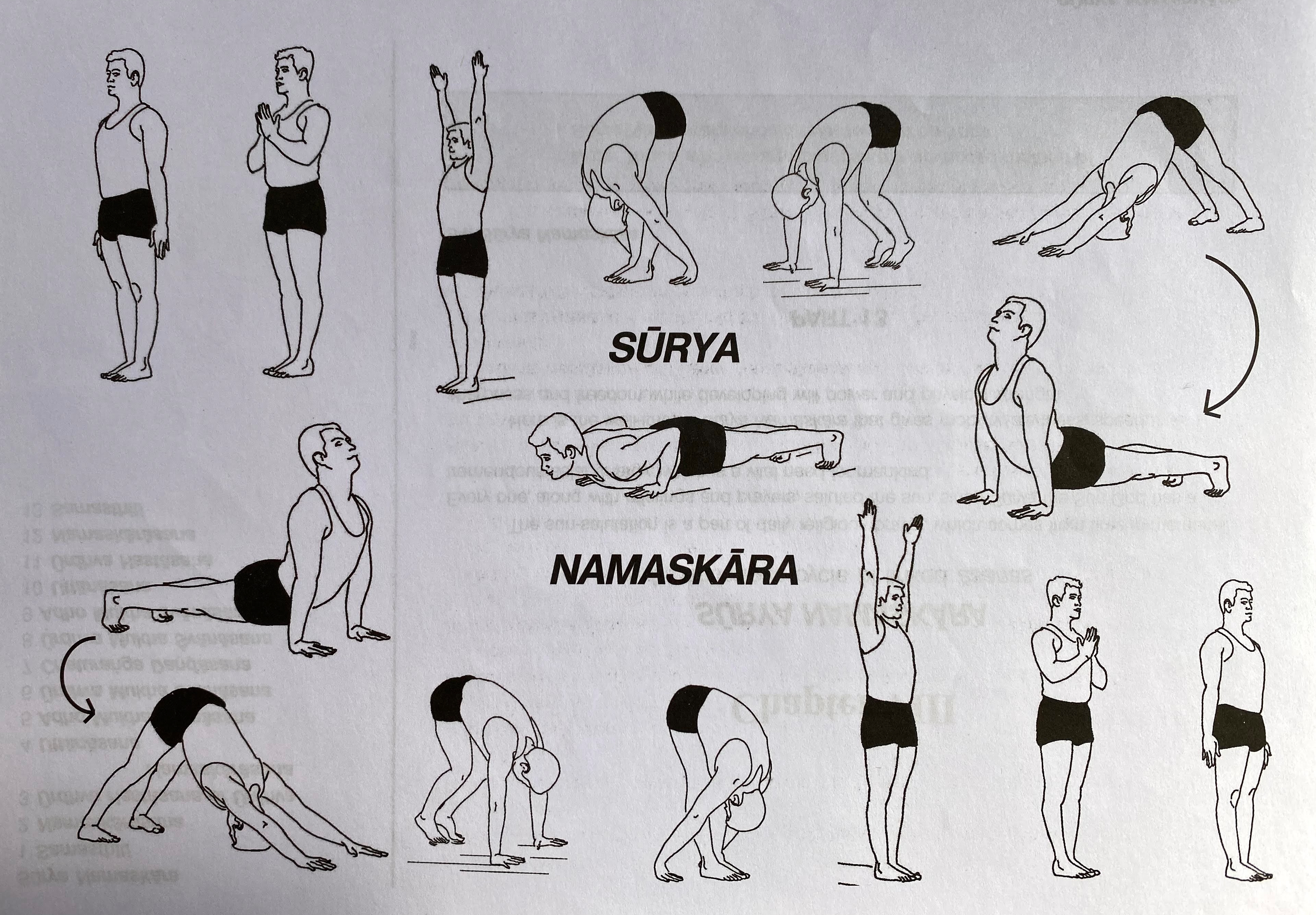
Here is a sheet to see how we practice surya namaskara at the Yoga Path. However, as my teacher Margaret Hahn use to say, “the sun salutation is like potato salad. Everyone has their own recipe.: Just Google surya namaskara / sun salutations to get a couple of thousand variations on a theme. Below is pictured the Iyengar version from the Preliminary Course book.

Just practice it for yourself and for the others in your life. It can do nothing but good! You still have 10 days to go.

Filed under: Education, Uncategorized, Virtual Yoga, , , , ,

De-stressing pose

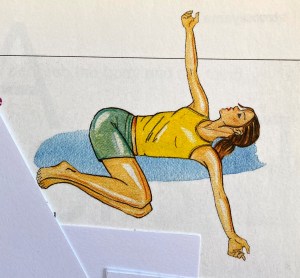
YOU CAN USE YOUR asana practice as a tool to de-stress physically, physiologically, and psychologically, body, mind, and spirit. Creating a position that allows for deep. deliberate diaphragmatic breathing will calm and relax the autonomic nervous system. The reclining twist shown in this picture will provide relief to agitated adrenal glands, the source of much of the stress hormones in the body.

img_0945

Jathara Parivartanasana

Lay on your back with you arms straight out from the shoulders. Palms up or down depending on what feels most grounded. Tuck you knees and drop you legs to the right. If it’s hard on the low back, tuck the knees more and/or leave you feet on the floor when going to the side. As you twist to the right, bring your attention to your left mid-band along the bottom of you rib cage. Find the spot above you left kidney where you feel the physical movement of you breath. Relax and hold this from 2 – 5 minute, working with your breath and body. Don’t twist the neck. Gaze up and yes maybe even close your eyes. When you come out, bring up one leg at a time. Do the other side.

Repeat as often as you want. But if you find yourself agitated before doing this, do some active standing poses to get you warmed up and your heart going. (Maybe even some sun saluttations). This gentle twist floods the adrenals–located on top of the kidney–with nourishment and opens them to the breath.

Filed under: Education, Virtual Yoga, , , , ,

We Still Can Practice

img_0808Greeting to all on this first day of Spring. The equinox is when day and night are in balance, at least  in some latitudes. Though balance is what we are looking for in the coming days. And isn’t balance what we most crave now with the tumult about us?
With that in mind I’m going to try to revive the Yoga Path blog as means to reach out to all students past and present who have embraced this journey. I will be bringing you posts of  various content exploring just what can be shared that might be helpful.  That way, those who wish can check it whenever they want. Rather than intruding on your lives with yet another email or text, I will offer teachings and practices to help your own practice in the coming weeks.

We are really so fortunate to have taken up this path of Yoga. What we’ve practiced and learned in the past at the school, can be an aid to help us open to this new normal in our life. You already have the flexibility and fluidity to open to this changing world and be receptive to the gifts and burdens that enfold everyday. As well as recalling that we can live happily in the present moment simply by remembering that we already have more than enough conditions to be happy.

Feel free to comment and contribute anytime on this blog.  It can be like having tea in circle at end of our asana practice. We can all benefit from each others’ wisdom.

“If you do not bring the kind eye of creative expectation to your inner world, you never find anything there. The way you look at things is the most powerful force in shaping you life. In a vital sense, perception is reality. “ John O’Donohue from Anam Cara


Filed under: Education, Virtual Yoga

More on Blue

IMG_0293

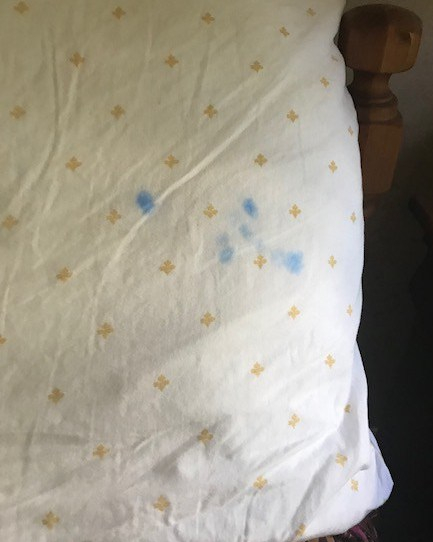
Entitled: Blue dot on pillowcase

The recent assignment to notice the color blue wherever you see it, has been very interesting at the Yoga Path. It went well for the first week when many put a blue dot on their hand and wrist to be reminded to watch for it. We did this with permanent mark from a blue sharpie. I myself refreshed it daily with each class. Unfortunately the permanent marker was not so permanent, so it would soon wash off in a few days with frequent hand-washing. The blue could also transfer to you pillowcase and bed sheets, where it proved to be much more permanent than on human skin.

Nevertheless, the task of noticing blue yielded a few insights and some appreciation for this remarkable ability to see and distinguish the subtleties of color. But blue has mystery all it’s own. As the last Radiolab story revealed, blue is the last color the human consciousness notices. But Rebecca Solnit in A Field Guide to Getting Lost, examines our relationship to this color in life:

The world is blue at its edges and in its depths. This blue is the light that got lost. Light at the blue end of the spectrum does not travel the whole distance from the sun to us. It disperses among the molecules of the air, it scatters in water. Water is colorless, shallow water appears to be the color of whatever lies underneath it, but deep water is full of this scattered light, the purer the water the deeper the blue. The sky is blue for the same reason, but the blue at the horizon, the blue of land that seems to be dissolving into the sky, is a deeper, dreamier, melancholy blue, the blue at the farthest reaches of the places where you see for miles, the blue of distance. This light that does not touch us, does not travel the whole distance, the light that gets lost, gives us the beauty of the world, so much of which is in the color blue.

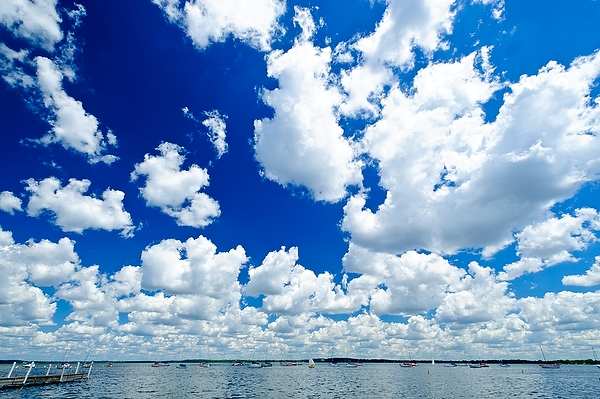
Big_sky_boats12_9682For many years, I have been moved by the blue at the far edge of what can be seen, that color of horizons, of remote mountain ranges, of anything far away. The color of that distance is the color of an emotion, the color of solitude and of desire, the color of there seen from here, the color of where you are not. And the color of where you can never go. For the blue is not in the place those miles away at the horizon, but in the atmospheric distance between you and the mountains.”
 

Filed under: Blue, ,

Seeing Blue

Right now in classes we’re practicing see the color blue in our everyday life. Just when you see blue, notice that you’re seeing blue.  I have to admit that I’ve borrowed this idea from the book: How to Train a Wild Elephant: And Other Adventures in Mindfulness by Jan Chozen Bays, MD.

But blue is a unique color, it’s the last color we notice in our development consciousness and the least seen in nature. Some ancient and primitive cultures don’t even have the word in their lexicon.

The following is a very interesting story from RadioLab that talks about this enchanting color color. Listen, and look for blue:

https://youtu.be/um6j_WRDggs

Filed under: Blue

2018 Mindfulness Retreat

Home Practice

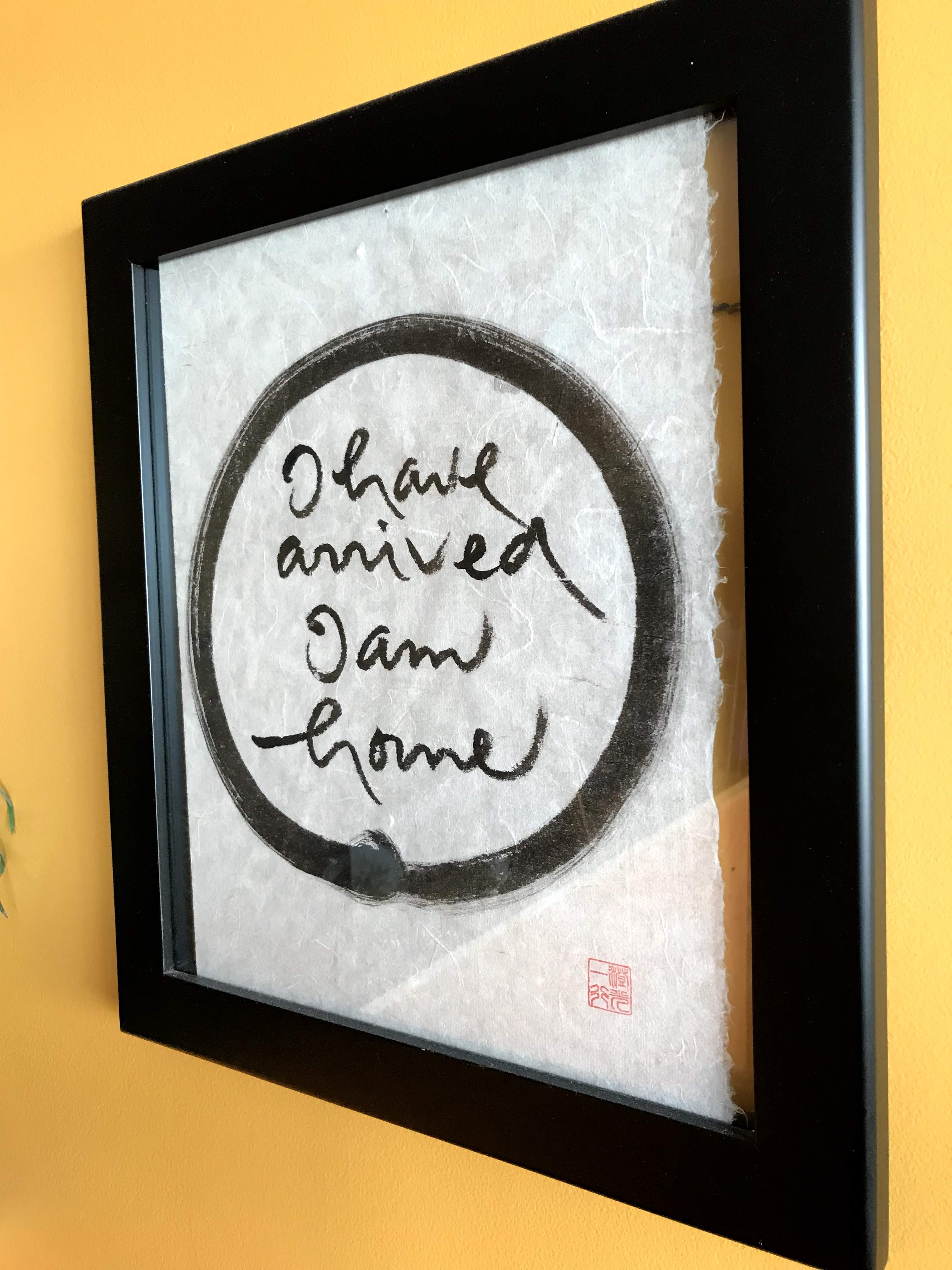
“Going Home”


Exploring Life’s Journey into Ourselves:

A Mindfulness Retreat


 April 26 –  29, 2018

Filed under: Education

Climbing Trees

Filed under: What You Can Do about Climate Change

Mother Trees

Filed under: What You Can Do about Climate Change

Iyengar’s Legacy

This is very simple video the shows the impact of BKS Iyengar’s teaching.  Wait to watch it when you have 24 minutes to devote yourself to it.

“>Sadhaka: the yoga of B.K.S. Iyengar

Filed under: Education

Tea on the Brain

Been a long time since making an entry in this category — tea, but I always marvel at the relationship of tea in Buddhism, Yoga, and meditation. Now here is a neurological explain for human predilection for Camellia sinensis.

Filed under: Tea, , , , ,

Enter your email address to subscribe to The Yoga Path Blog and receive notifications of new posts by email.

Join 676 other subscribers
Visit our Site